

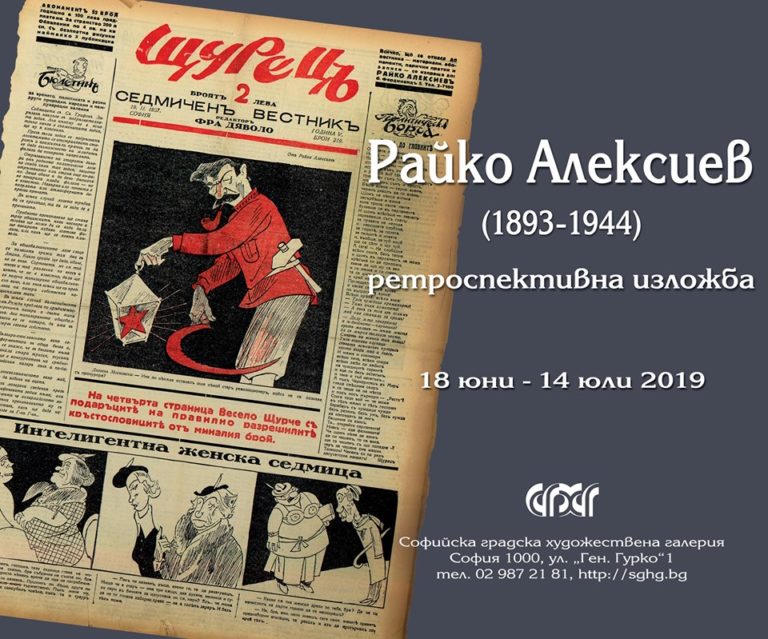
After 26 years since Rayko Alexiev's last exhibition, it is time to remember who he is. Is he just the name of a gallery in Sofia or a significant character from the tragic events of the autumn of 1944?
He was born in 1893 in Thessaloniki to a family of teachers from Panagyurishte. The family moved from city to city until they settled in Vratsa, where he drew his first cartoons and completed his high school education. He graduated from literature at Sofia University and attended the Drawing School. At the age of eighteen, he became a contributor to the humorous magazine "Baraban", and the following year he was an editor and main cartoonist in the humorous magazine "Lyudokos".
In 1914, he competed with the father of Bulgarian cartooning, Alexander Bozhinov, in the magazine "Laughter", edited the Cartoon Week in the extremely popular illustrated magazine "Az znam vshisti", and held his first solo exhibition in Vratsa. The following year he toured Macedonia as an artist, and organized an exhibition of his drawings at the Permanent Art Gallery in Sofia. Despite the negative articles by Boris Vazov and Konstantin Shtarkelov in the newspaper "Mir", he sold almost all of his paintings and sketches. Among those who bought his works were: famous Bulgarian industrialists, prominent families of the capital, Tsarina Evdokia, as well as the National Museum.
During the years of the First World War, with his extremely sharp caricatures in the leading magazines "Bulgarian" and "Baraban", Rayko Alexiev soon surpassed the doyen Alexander Bozhinov. He published the collections "Dushespasitelna knjitza" and "Shturets".
After the end of the war, he held his third solo exhibition, participated in the organization of the House of Arts. During the years of dramatic events - the June 9th coup, the September Uprising, the attack on the "St. Nedelya" church and the subsequent terror, he was away from the battlefield of caricature.
He lived in Germany, traveled in Italy – a period about which we know almost nothing. In 1925, he directed and played the main role in the comedy film “The Insidious Princess Turandot”, initiated the documentary film “Bulgaria in Pictures”, illustrated and compiled (together with Dimitar Podvejachov and Marin Vlaykov) reading books for the I, II and III departments. His characters Gunyo Guskov and Father Taraponti were born in the newspaper “Zora”, and the first publication of “Humorous History of the Bulgarian People” was also there.
His marriage to the young actress Vesela Grancharova was probably the main impetus for him to embark on the adventure of publishing an independent humorous newspaper, which appeared to the delight of the people of Sofia at the end of 1932 and continued to be published until the end of the Third Bulgarian Kingdom. The feverish activity of writing the weekly "Shturets" did not prove to be an obstacle to Rayko Aleksiev's other public service activities as chairman of the Union of Artists' Societies. During his four terms in office, he opened the gallery at 125 Rakovski Street, which now bears his name, organized financial assistance for the members of the Union, and defended persecuted communist artists before the authorities.
After September 9, 1944, he alone, among the other arrested cartoonists Alexander Bozhinov, Alexander Dobrinov, and Konstantin Kamenov, was beaten for more than a month (without leaving written statements), until he was reduced to unrecognizable and died in the Red Cross hospital.
The people of Radoi Ralin's generation, who had eagerly awaited the appearance of his "Shturets", are no longer alive today. We, the contemporaries, must ask ourselves whether we know our own history from the perspective not only of the events, but also of the excitements of the previous generations who experienced the turbulent times of the first half of the 20th century. Can what he has drawn now move us or make us laugh? Is he just one of our best caricaturists or is he also a painter whose works have value for the history of Bulgarian art?
The exhibition at the Sofia City Art Gallery is an occasion to seek answers to these questions.
Opening: June 18, 2019, 6:00 PM
Place: Sofia City Art Gallery, 1 Gen. Gurko Str.
Closing: July 14, 2019
Source: Sofia City Art Gallery
Add comment